Budget
Under thirty euros: where a knife stops being a compromise
A cheap knife is not necessarily a bad one. What separates a real knife from a pressed shape is whether the listing names its steel, states a hardness and publishes an edge angle. Below thirty euros most listings give none of the three; these five give at least one.
By Jean-Benoit Buisson
Five knives under thirty euros that tell you something.
The one that publishes its bevel
The Paudin santoku, 17.8 cm in 5Cr15MoV with a 13° double bevel, pakkawood handle, stated for left- and right-handed use. A published angle is what lets you sharpen it back to what it was.
The one with a wooden handle
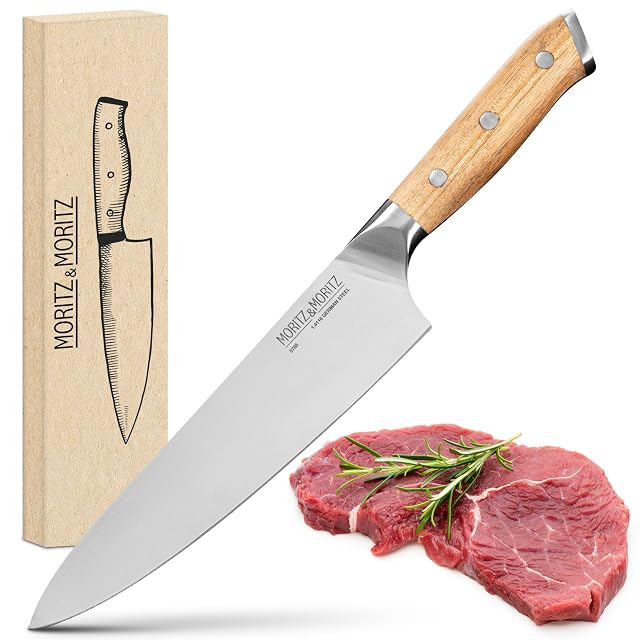
The Moritz & Moritz 20 cm chef’s knife in German knife steel with an acacia handle. “German knife steel” is a description rather than an alloy designation — the honest limit of this listing.
The small one
The Paudin 9 cm paring knife, same 5Cr15MoV, same pakkawood, stated rust resistant and ambidextrous.
The one with the named alloy
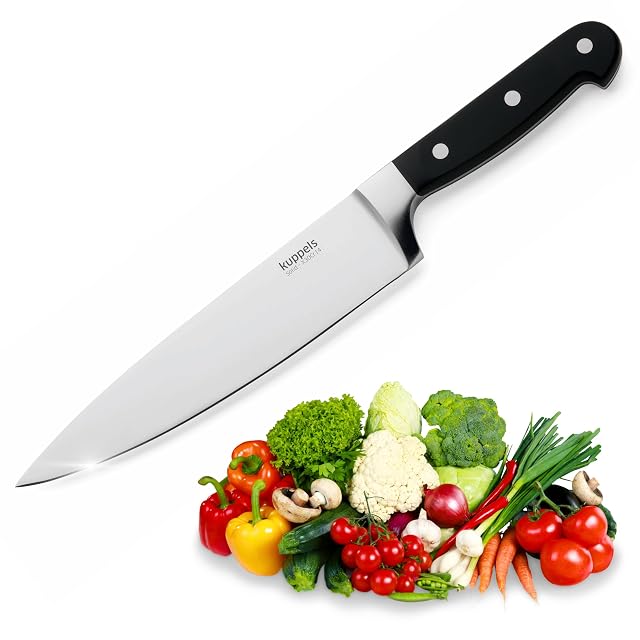
The Kuppels 20 cm in X30Cr14 chrome-vanadium hardened steel, full tang and balanced. Full tang means the steel runs the length of the handle, which is a construction claim rather than a material one.
The cheapest with a real process claim
The Tefal santoku, 18 cm, stated ice-hardened to −120 °C in German stainless, with a finger guard. Cryogenic treatment is a genuine step in knife making, and stating a temperature is more than most listings at any price.
What thirty euros does not buy
A forged blade, a Damascus lamination or a hardness above about 56 HRC. Those start higher up, and none of them makes a knife sharper than a whetstone does.