Choosing
Coated or uncoated: two pans, two entirely different deals
This is not a question of quality. A coated pan is a consumable that works immediately; an uncoated stainless or iron pan is a tool that has to be learned and then never replaced. Most kitchens want one of each, and the mistake is buying two of the same kind.
By Jean-Benoit Buisson
Two entirely different transactions, and both are reasonable.
What a coating buys
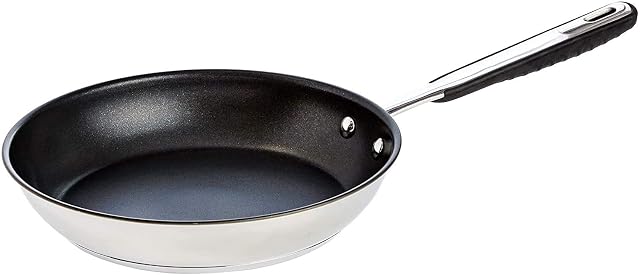
Immediate release. Eggs, fish and pancakes work on the first day with no technique. The 28 cm Amazon Basics pan — nonstick over stainless with an aluminium core, oven safe, dishwasher safe — is the cheapest complete version of that deal.
What a coating costs
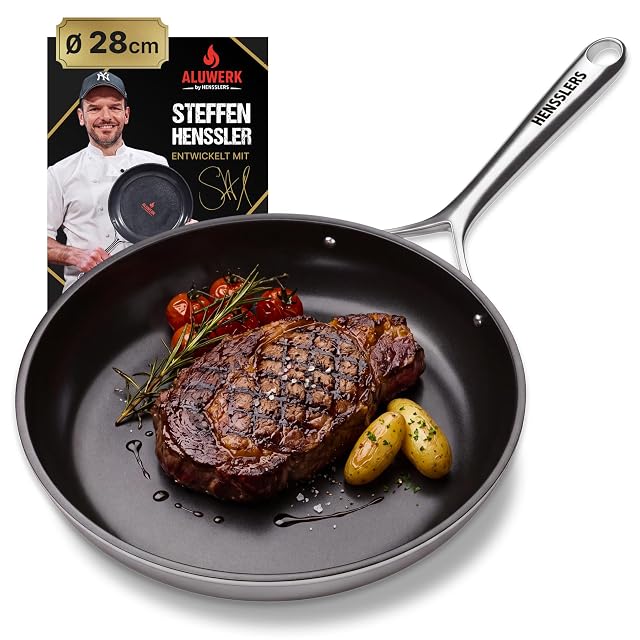
Time. Every coating wears. There is no coated pan that lasts a decade of daily use, and the price of a premium coated pan does not change that: the Aluwerk 28 cm has a titanium-reinforced ceramic surface, a heavy cast body and a solid stainless cold handle, and it is still a consumable.
What uncoated buys
Permanence and heat. The Tefal 28 cm uncoated textured stainless is oven safe to 250 °C and dishwasher safe; the Waldwerk 28 cm is 100 % uncoated stainless with a removable leather handle sleeve. Neither will ever need replacing because a surface failed.
What uncoated costs
A month of learning. Food sticks until the pan is preheated properly and a film of fat is in it. That is a real cost and it is the reason people give up on stainless.
The third option
Bare cast iron. The Tecor 28 cm is unground, pre-seasoned with vegetable oil, with high sides. Seasoning is a surface you build rather than buy, and — uniquely — one you can repair.
The answer for most kitchens
One of each. A coated 28 cm for eggs and fish, and an uncoated 28 cm for everything that wants a hard sear.